I didn't build Corporate Digital Responsibility / CDR framework to collect data. I built it to return accountability to where data is owned.
I watched digital become the strongest medium — while consent stayed buried in fine print. CDR 2.0 is my open framework for immunity by isolation, zero retention, and brand loyalty first.
From CSR 1960s to Digital Thorn
Corporate Social Responsibility emerged in the 1960s as a moral compass. Five decades later, the digital explosion rewired that compass. I watched it happen — today 50% of humanity is hooked to screens, 70% of companies depend on digital for revenue.
From radios in the 1970s to TV, mobile, internet — even vegetable vendors now accept smartphones. I watched Digital Media become the strongest medium: dynamic, targeted, analytics-driven. Corporate work moved to email and video conferencing.
Yet a thorn remained — privacy hidden in fine print, consent buried in clicks, loyalty traded for targeting. I saw brand building become performance marketing, trust become a checkbox.
CDR 1.0 was my first attempt to fix this, but gaps remained: accountability without ownership, consent without comprehension, data flow without transparency. It was a necessary draft, not a final immunity. That's why I evolved it to CDR 2.0 as open framework.
Understanding CDR 1.0 — The Moral Compass Before Immunity
In 2014, I defined Corporate Digital Responsibility as "the norms of appropriate and responsible corporate behaviour with regard to digital data management and related technology use" — brand building that increases brand loyalty, not data rent.
Ownership means liability.
Data Owning is not asset holding. When you own data, you own its failures, lineage, and legal debt. Accountability cannot be outsourced.
Beyond encryption — forward secrecy.
Vocal signatures, biometric recognition data, video consent payloads — encryption is baseline. Forward secrecy, custody, prohibition, destruction are governance.
How data is queried, correlated, inferred.
Pressure handling, behavioural change detection, confidence scoring must be logged. Ethics is not static policy but motion audit.
Ethics cannot be compromised no matter what the odds.
Board-level metric. Ethics Override hardwired. Governance that compounds speed must never trade ethics for velocity.
Contribution without appropriation.
Data Contribution is not harvesting. When you benefit from data, you must return value, provable deletion, and transparent purpose. No monetization of residual traces.
Wayback 4 Captures to Patent 551315 Grant — The Full Timeline
CDR 2.0 – Human Identity Data Beyond PII. Governed.
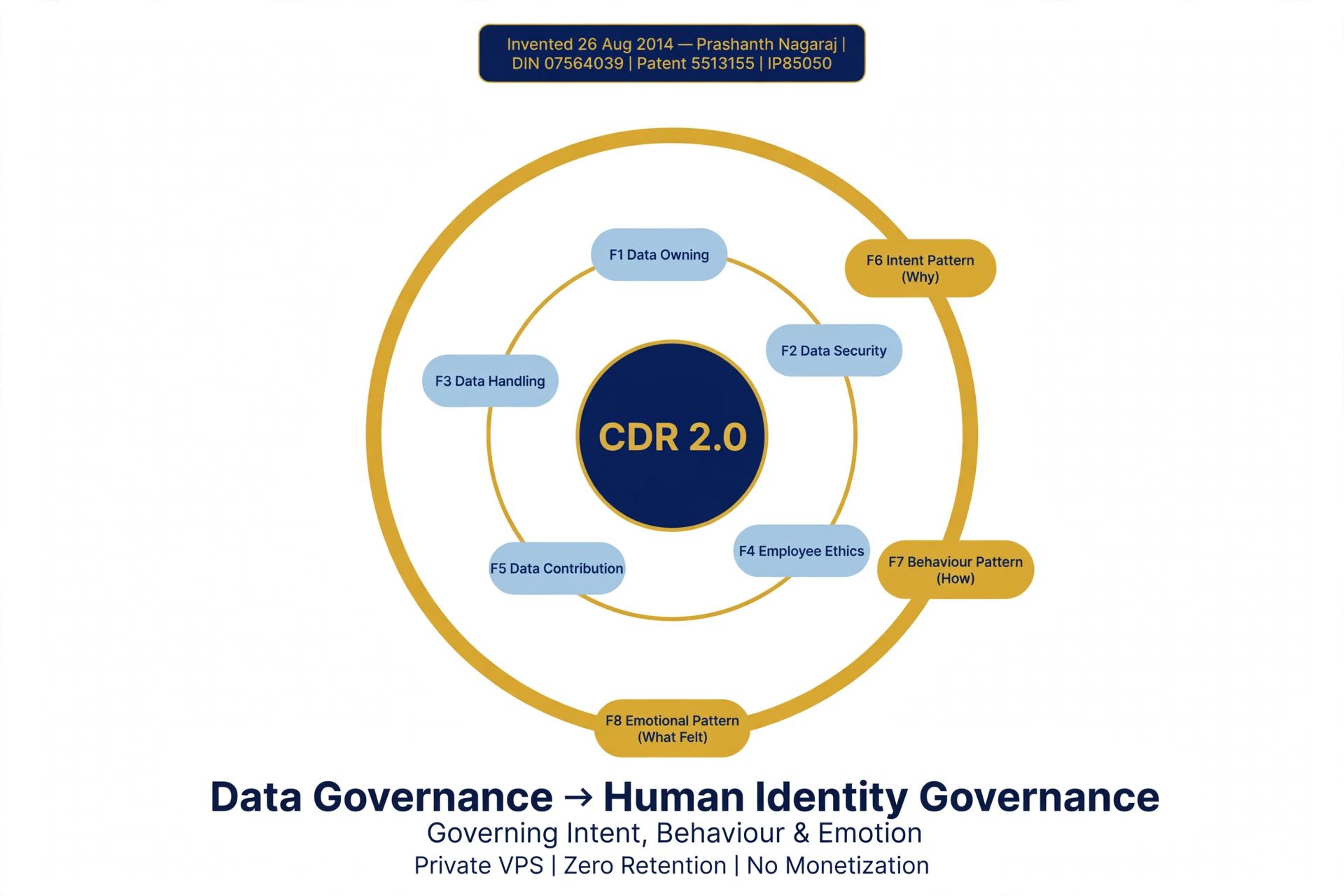
In 2014 we governed storage. In 2026 we must govern inference. Agentic AI doesn't just hold your data — it scores your intent, your hesitation under pressure, your emotion from voice and face. A password can be reset. An Intent, Behaviour, Emotional Pattern cannot — that's Human Identity Data Beyond PII. CDR 1.0 logged what happened. CDR 2.0 — F6 Intent Pattern, F7 Behaviour Pattern, F8 Emotional Pattern — logs why you did it, how you behaved under pressure, what you felt. Patent 551315 Claim 1 & 2 and IP85050 36 claims make it auditable under EU AI Act 5(1)(f) & 50(3). Private VPS immunity: session ends, memory ends. No ledger. No ad graph. With what and why italic serif.
From Storage to Inference: The Eight-Function Framework for an AI-Dominated World
F1–F5: CDR 1.0 foundation (2014) — what happened. F6–F8: CDR 2.0 extension (2026) — why, how, and what you felt. Human Identity Data Beyond PII.
Ownership means liability.
Data Owning is not asset holding. When you own data, you own its failures, lineage, and legal debt. Accountability cannot be outsourced.
Beyond encryption — forward secrecy.
Vocal signatures, biometric recognition data, video consent payloads — encryption is baseline. Forward secrecy, custody, prohibition, destruction are governance.
How data is queried, correlated, inferred.
Pressure handling, behavioural change detection, confidence scoring must be logged. Ethics is not static policy but motion audit.
Ethics cannot be compromised no matter what the odds.
Board-level metric. Ethics Override hardwired. Governance that compounds speed must never trade ethics for velocity.
Legit, logical, non-polluted.
Ecosystem integrity. No synthetic inflation, no dark pattern telemetry. Contributions must be legitimate and attributable.
Why a person does what they do
Sequence of inferred goals, prompt strategies, action-selection biases. VIHA framework for Agentic AI.
How a person behaves over time
Pressure handling, confidence scoring, hesitation markers, behavioural changes. Human Identity shield for Agentic era.
What a person feels, inferred
Emotion inference prohibited workplace/education — Art 5.1(f). Not PII — custody, prohibition, audit. Human Identity Data.
Immunity by Isolation
Not public cloud. Isolated viewer, zero shared infra, board-only access. Leakage surface reduced to one.
No Emotion Ledger
No behavioral history kept. Session ends, data ends. No monetization path, no emotional graph.
Brand Loyalty First
Revenue from governance, not from data exhaust. Loyalty compounds speed when trust is non-negotiable.
CDR 2.0 Whitepaper: From Framework to Board-Ready Implementation
What it talks about: Whitepaper 31 pages covers CDR 2.0 8 Functions — Original 5 adapted to AI era + New 3 Intent Behaviour Emotional — implemented in Patent 551315 Autonomous Recruitment Claim1 pressure handling confidence scoring behavioural change detection Claim2 vocal/physical impersonation — IP85050 VIHA Intent 12 claims — EU AI Act mapping Art 5.1(f) Art 50 — Private VPS Zero Data Retention Architecture — Board-level Stewardship model — Governance That Compounds Speed — Proof Wayback 4 Captures DIN 07564039 Patent IP85050
Why useful: For Boards to audit why AI judged under pressure, For Compliance teams to map EU AI Act emotion inference prohibition and transparency, For Product teams building agentic AI to govern agent conduct, For Investors due diligence on human identity data risk, For HR to protect employees from low confidence scoring.
How reading full helps: Full 31 pages gives implementation checklists, claim mapping, audit templates, board resolution language, technical immunity architecture.
 IP85050 PROTECTED • SECURED VIEWER
- ✓Implementation Checklists for F1–F8
- ✓Claim Mapping — 551315 + IP85050 (36 Claims)
- ✓Audit Templates for Art 5.1(f) & Art 50 — EU AI Act
- ✓Board-Level Stewardship Model & Resolution Language
- ✓Technical Immunity Architecture — Private VPS, Zero Shared Infra
- ✓Human Identity Data Taxonomy — Beyond PII (Intent/Behaviour/Emotional)
- ✓Wayback Proof Pack — DIN 07564039, 4 Captures, Patent Grant 27 Sep 2024
- ✓Pressure Handling & Impersonation Safeguards — Claim1 & Claim2 Specs
Whitepaper — CDR 2.0 Immunity Final
Exact PDF render — pages 1-8 preview — no blur — 31 pages total Current: Page 3 / 31
Ready to read full 31-page secured copy?
Email watermarked, IP-tagged, traceable — Private VPS Zero Retention viewer, IP and location captured for SEO + security audit. No forwarding. Board evaluation only.
31 watermarked, traceable with email and company. Watermark applies with name, IP, timestamp all over document.